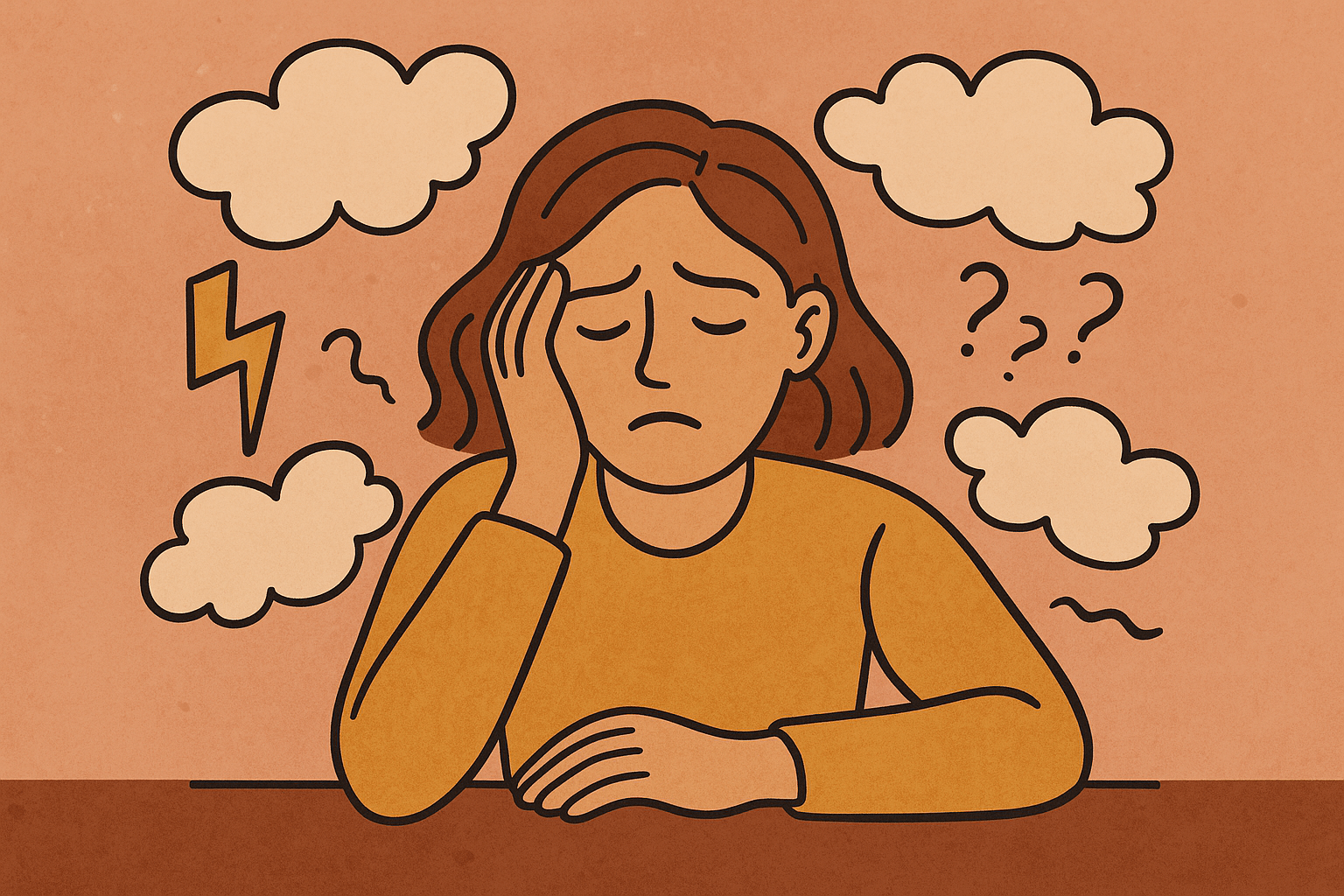
🧠 When Your Mind Feels Like Molasses
It starts with a forgotten appointment. A lost word. A sentence that drifts mid-thought and never returns. Then comes the heaviness, like your brain is wrapped in cotton—and no amount of sleep, caffeine, or willpower can cut through the fog.
You might call it “feeling off.” Or “tired all the time.” But if you’re living with multiple sclerosis (MS), chronic illness, trauma, or even mental health challenges, what you’re describing likely has a name:
👉 Brain fog.
👉 Chronic fatigue.
And it’s not your fault.
This article explores what brain fog and fatigue really are, why they’re so misunderstood, and—most importantly—how to stop blaming yourself for something that’s neurological, not moral.
Looking for online therapy? Click here.
🔍 What Is Brain Fog, Really?
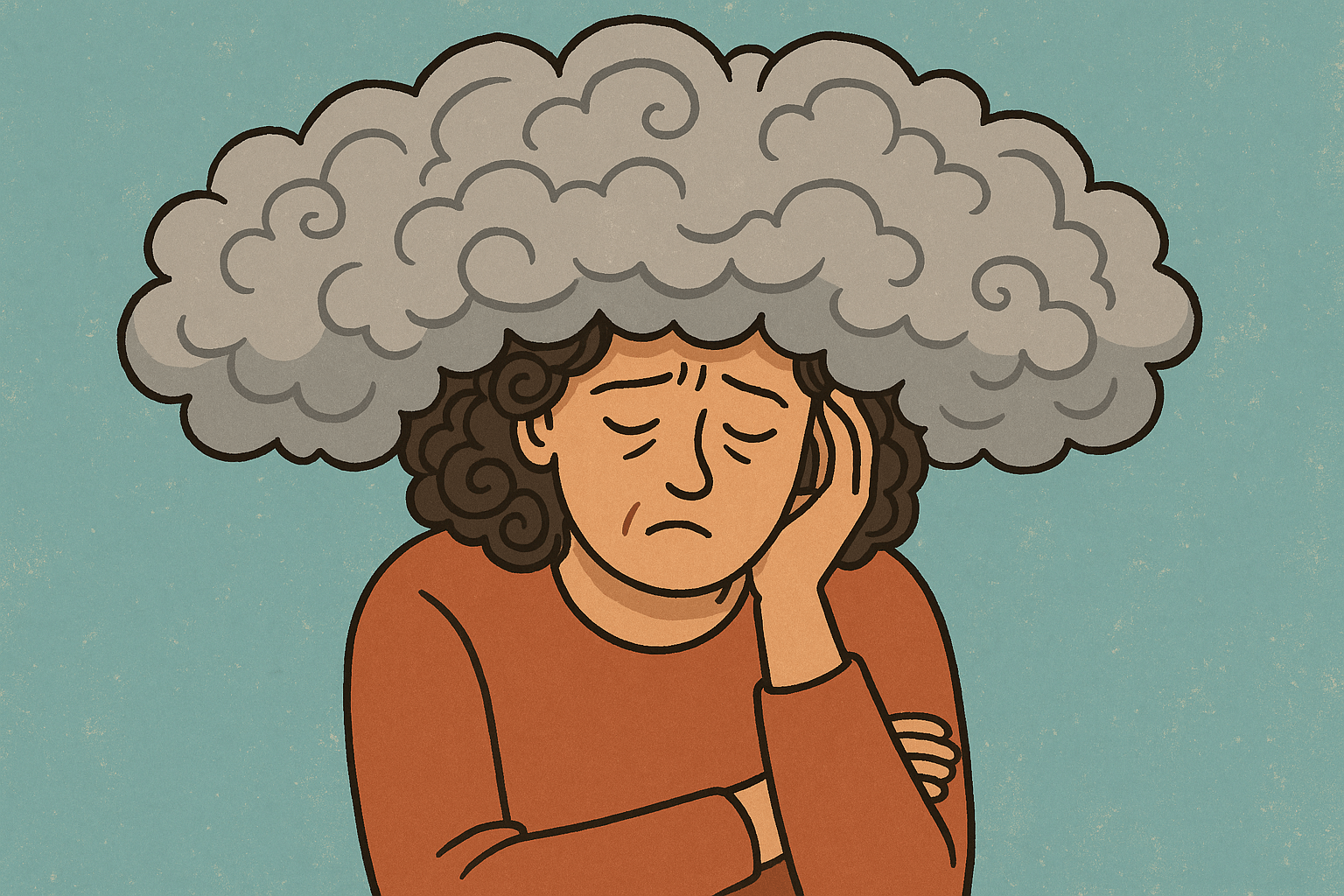
“Brain fog” isn’t a clinical diagnosis, but it’s a well-documented cognitive symptom. It describes a mental state where thinking feels slowed, clouded, or disconnected.
Common signs include:
- Difficulty concentrating
- Forgetting words or names
- Slower processing speed
- Struggling to make decisions
- Feeling spaced out or detached
- Needing more time to complete simple tasks
Brain fog is frustrating because it affects how you move through the world, yet it’s invisible to everyone else.
🛌 What Is Chronic Fatigue?
Fatigue in chronic illness isn’t the same as “normal tired.” It’s a deep, cellular exhaustion that isn’t relieved by rest.
Chronic fatigue in MS and similar conditions may:
- Feel like your body is made of lead
- Hit without warning, even after a full night’s sleep
- Get worse after mental effort, not just physical
- Be unrelated to activity—some days you wake up exhausted
- Make basic tasks (showering, cooking, walking) feel monumental
Still, people around you might say:
- “You just need to push through.”
- “Get some fresh air.”
- “Everyone gets tired.”
This mismatch between experience and perception is what often leads to self-blame.
😔 The Hidden Shame of Cognitive Fatigue
You forget to pay a bill.
You cancel plans again.
You can’t follow a conversation in a noisy room.
And suddenly your brain whispers:
“You’re lazy.”
“You’re unreliable.”
“You’re failing.”
“Why can’t you just try harder?”
These thoughts are not true—but they are common.
We live in a culture that equates energy with worth, clarity with intelligence, and productivity with moral value. So when your brain or body slows down, you might internalize it as failure.
But let’s be very clear:
🚫 You Are Not to Blame for Symptoms You Didn’t Choose
Fatigue and brain fog are not personality flaws. They are neurological or physiological symptoms of real conditions—including:
- Multiple Sclerosis (MS)
- Long COVID
- Fibromyalgia
- Chronic fatigue syndrome (ME/CFS)
- Depression and anxiety
- ADHD
- PTSD
- Hormonal changes (e.g., perimenopause)
- Autoimmune disorders
Telling yourself to "just snap out of it" is like telling someone with a broken leg to walk faster.
🧬 What Causes Brain Fog and Fatigue?
Many overlapping biological processes can trigger these symptoms:
🧠 Neurological inflammation
In MS, for instance, inflammation in the brain and spinal cord disrupts communication between neurons, affecting memory, focus, and energy.
⚖️ Dysregulated nervous system
When the autonomic nervous system is on high alert (often due to trauma, illness, or chronic stress), it leads to fatigue and cognitive exhaustion.
🩸 Blood sugar and oxygen issues
Some chronic illnesses affect blood flow or nutrient delivery to the brain, making it harder to think clearly.
🔋 Energy metabolism dysfunction
In conditions like ME/CFS, the body has trouble producing cellular energy (ATP), leading to a profound energy crash.
💊 Medications and side effects
Many medications used to treat MS or mental health issues (e.g., antidepressants, muscle relaxants) can contribute to fogginess.
📉 The Psychological Cost of Not Being Believed
One of the most damaging aspects of brain fog and fatigue isn’t the symptom itself—it’s how others respond to it.
When your challenges are minimized or misunderstood, you may begin to:
- Doubt yourself (“Maybe I’m making a big deal out of nothing.”)
- Overcompensate (“I need to do more to prove I’m still capable.”)
- Withdraw (“I’ll just stop telling people how I feel.”)
This internalization of ableism—especially the invisible kind—can become a secondary source of suffering. It makes it harder to rest, advocate for yourself, or accept what your body needs.
🧘 How to Stop Blaming Yourself
Here’s what you can do instead of blaming yourself for your brain fog or fatigue:
💬 1. Name It for What It Is
Say it out loud:
“This is neurological fatigue.”
“This is a symptom of chronic illness, not a personal failure.”
“My brain isn’t broken—it’s just overwhelmed.”
Naming the symptom helps externalize it. You stop seeing it as part of your identity and start seeing it as something you’re experiencing.
🛑 2. Interrupt Negative Self-Talk
When your inner critic says:
“You’re so lazy.”
Try responding with:
“I’m not lazy. My body is asking for recovery.”
You might write out compassionate rebuttals or use post-it notes as gentle reminders. Every time you challenge the voice of shame, you reclaim a little more space for truth.
🫂 3. Practice Self-Acceptance, Not Overcompensation
You don’t need to “make up” for your fatigue by being extra helpful, positive, or high-achieving. Instead, lean into radical self-acceptance:
“I am allowed to be tired. I am allowed to forget things. I am allowed to move slowly.”
📆 4. Create Pacing and Recovery Routines
Rather than pushing until you crash, build your days around energy conservation:
- Use the “spoon theory” or “energy envelope” models
- Schedule rest before you need it
- Keep meals, hydration, and blood sugar stable
- Build in brain breaks: silence, grounding, breathing
- Allow downtime after social or medical appointments
Rest isn't optional—it's your neurological medicine.
🗣️ 5. Educate Your Support System
Help the people around you understand by using metaphors:
- “It’s like my brain’s Wi-Fi is down.”
- “I’m not tired from doing too much. I’m tired from existing in this body.”
- “Imagine trying to think through quicksand. That’s brain fog.”
Send articles, use visuals, or gently say, “This is what helps me feel seen.”
🤝 6. Connect with People Who Understand
Validation is powerful. Join communities of people who also experience brain fog and fatigue. Try:
- MS support groups
- Chronic illness forums (The Mighty, Reddit, etc.)
- Therapists who specialize in neurodivergence or chronic conditions
- Friends who say “I get it”—and mean it
Your experience is real. You are not alone.
🪷 7. Make Peace With Slowness
We live in a culture addicted to speed. But slowness can be sacred.
Letting your brain work at its pace isn’t “falling behind.” It’s honoring your internal rhythm.
Try affirming:
“I can slow down and still be whole.”
“My worth isn’t measured by how sharp or fast I am.”
❤️ You Deserve Compassion, Not Criticism

Brain fog and fatigue are not choices. They are signals—messages from your body asking for gentleness, recovery, and care.
Blaming yourself won’t make the symptoms go away. But compassion? That’s where healing begins.
🧩 Final Thoughts
You are not lazy.
You are not failing.
You are not broken.
You are living in a body that needs support, not shame.
The fog will come and go. Fatigue will have its rhythms. But your self-worth? That can stay steady—grounded in truth, held in compassion, and free from blame.
You are doing your best. And that’s enough.
Even on foggy days.
Looking for online therapy? Click here.
📚 References and Resources
National Multiple Sclerosis Society. (n.d.). Cognitive Changes. Retrieved from https://www.nationalmssociety.org
MS Society UK. (2023). MS Fatigue and Brain Fog: What You Need to Know. Retrieved from https://www.mssociety.org.uk
Institute of Medicine (US) Committee on the Diagnostic Criteria for Myalgic Encephalomyelitis/Chronic Fatigue Syndrome. (2015). Beyond Myalgic Encephalomyelitis/Chronic Fatigue Syndrome: Redefining an Illness. National Academies Press.
Cleare, A., et al. (2021). Chronic fatigue syndrome and its overlap with other conditions. BMJ, 373:n830.
Brown, Brené. (2010). The Gifts of Imperfection. Hazelden Publishing.
Price, Devon. (2021). Laziness Does Not Exist. Atria Books.
The Mighty. (n.d.). Real-Life Experiences of Brain Fog and Fatigue. Retrieved from https://www.themighty.com
Tawwab, Nedra Glover. (2021). Set Boundaries, Find Peace: A Guide to Reclaiming Yourself. TarcherPerigee.